
Stainless steels are a family of materials that are essential in a wide range of industrial sectors, including medical, aerospace, automotive, tooling, energy, and electronics. Their properties make them indispensable for critical components.
However, even a material as high-performance as stainless steel requires considerable expertise to achieve its optimal performance. This is where heat treatments for stainless steel come in, a set of processes that improve the strength, dimensional stability, and durability of parts.
Understanding stainless steel: structure, families, and challenges of heat treatments
Stainless steel comes in several families, each characterized by a specific metallurgical structure. Austenitic stainless steels (type 304 or 316) are known for their excellent corrosion resistance, while ferritic stainless steels offer good temperature resistance. Martensitic stainless steels, on the other hand, are chosen for their high hardness after heat treatment.
Each family reacts differently to heat treatment: certain risks must be controlled, such as carbide formation, sensitization, or loss of ductility. Hence the need for heat treatment for stainless steel that is adapted to the characteristics of the material and the requirements of the part.
The main heat treatments suitable for stainless steel
Stabilization annealing
This treatment involves heating stainless steel to a high temperature to dissolve carbides and homogenize the structure. It alsoeliminates internal stresses resulting from machining or forming. The parts then benefitfromincreased corrosion resistance andimproved stability in service.
Income for martensitic stainless steel
In this family of steels, hardening produces a hard but brittle martensitic structure. Tempering improves ductility while maintaining good hardness. This process is particularly used for technical instruments, mechanical components, and certain medical parts requiring high precision.
Vacuum tempering
For stainless steel, vacuum is the benchmark technology. It limits oxidation, guarantees optimal surface cleanliness, and ensures remarkable treatment homogeneity . It is the preferred method for complex parts, surgical instruments, aeronautical components, and any application requiring impeccable quality.
Thermochemical treatments
Thermo-chemical treatments aim to enrich the surface of metal parts, particularly withnitrogen. The Thermilyon Group has developed specific treatments for stainless steels.
- For austenitic stainless steels: Thermi-SP is a low-temperature thermochemical treatment that hardens the surface of stainless steel without compromising its anti-corrosion properties.
- For martensitic, ferritic, and austenitic stainless steels: Thermi-Wearinox is an attractive alternative to salt baths, improving the anti-wear and anti-seizing properties of stainless steels. However, for this process, it is necessary to take into account the reduction in corrosion resistance.
Cryogenic treatment
Used as a complementary step after quenching, cryogenic treatment stabilizes residual phases by gradually lowering the temperature. It improves dimensional stability and can increase the service life of parts subjected to high stresses.
The effects of heat treatment on the properties of stainless steel
Appropriate heat treatment for stainless steel can improve the performance of a component. Heating and cooling cycles canbe usedtoadjust hardness,improve fatigue resistance, strengthen mechanical properties, oroptimize corrosion resistance.
The medical and aerospace industries, in particular, seek perfect dimensional stability, which is essential for ensuring the precise assembly of critical parts. The effects obtained vary depending on the type of stainless steel and the treatment chosen, but all serve a common purpose: to increase the reliability of the part over time.
The role of vacuum in the heat treatment of stainless steel
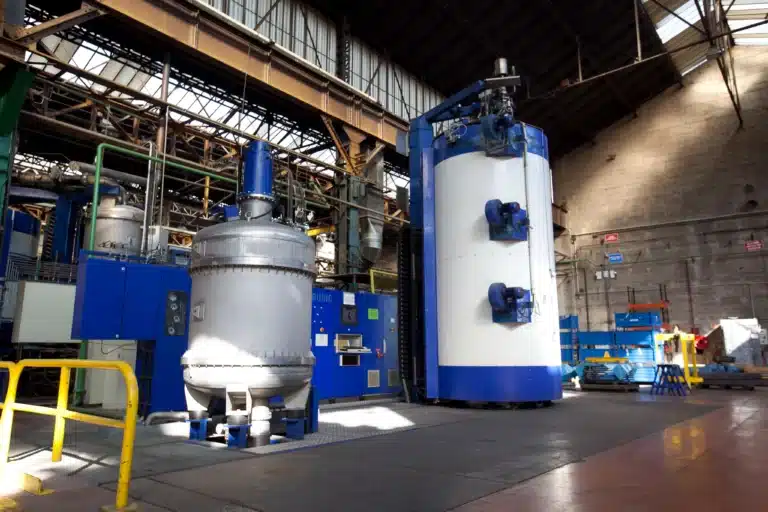
Vacuum plays a decisive role in the success of heat treatments applied to stainless steel. It protects the surface of parts from oxidation and guarantees perfect chemical cleanliness without contamination. The thermal cycle can be controlled with great precision, offering ideal reproducibility, even for large production runs.
Vacuum furnaces can also be used to treat complex geometries, sensitive surfaces, or components requiring a flawless surface finish, such as those used in the medical sector.
Combined heat treatments for superior performance
Depending on the requirements of the specifications,it is possible to combine several treatments: stabilization annealing followed by light tempering, vacuum quenching combined with a cryogenic chamber treatment or thermochemical treatment, or stress relief after machining.
These combinationsoptimize strength, ductility, and dimensional accuracy. For surgical equipment or aerospace components, this control over cycles is essential to guaranteeing final performance.
Heat treatment for stainless steel is a major lever for optimizing the performance, durability, and reliability of industrial components. Annealing, vacuum quenching, tempering, cryogenic treatment, or stress relief: each process meets a specific need.
By drawing on the expertise of the Thermilyon Group, manufacturers benefit from reliable technical support and unique know-how, guaranteeing the quality of the most critical parts.