


Home Hypertrempe

hYPERTREMPE

Objective: improve structural homogeneity, corrosion resistance and magnetic properties

Hyperquenching is a heat treatment regularly used to soften austenitic stainless steels.
Our process

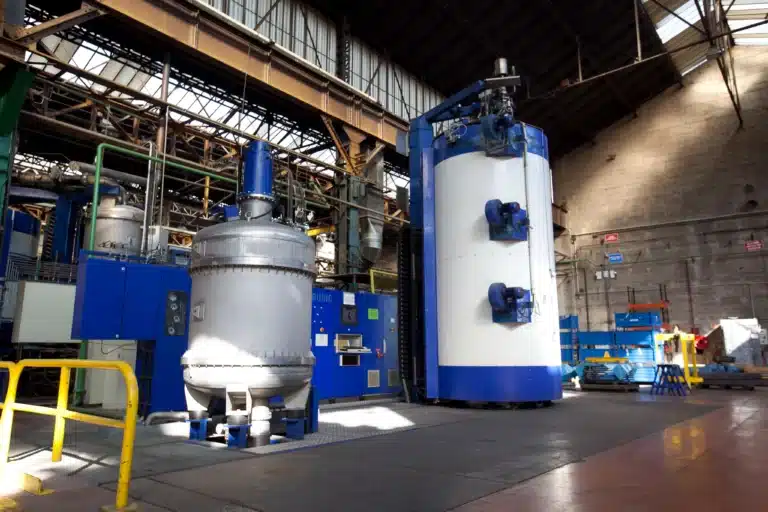
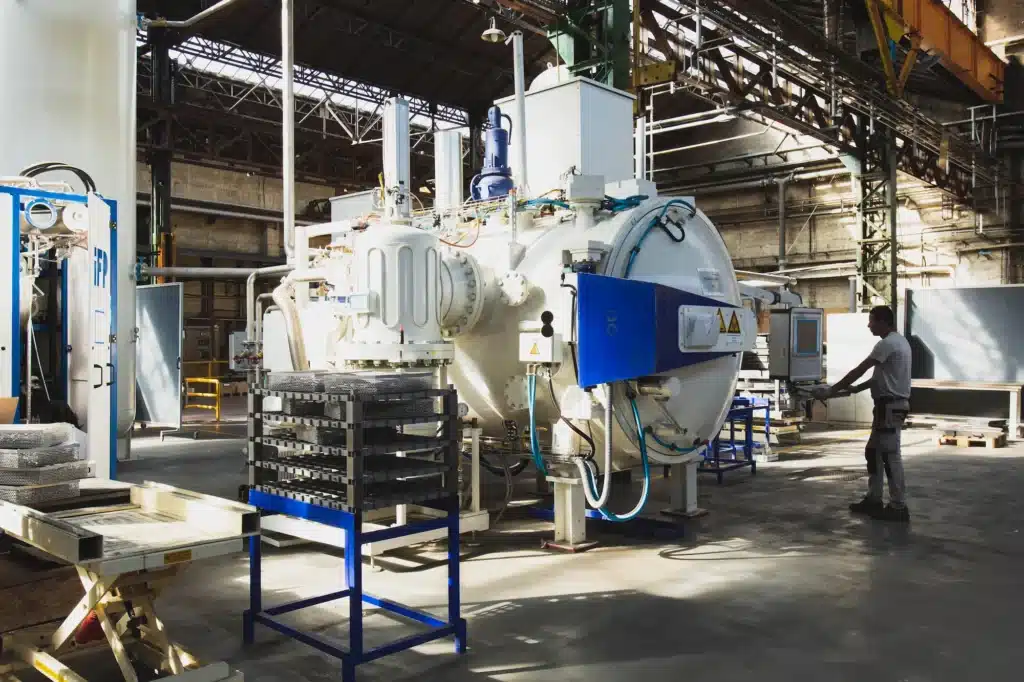
Hyperquenching is mainly carried out in vacuum furnaces to avoid oxidation and contamination.

Heating

heating to a temperature of around 950/1050°C, depending on the chemical composition of the steel. The temperature is held for a few minutes, depending on the thickness of the parts.

Cooling

Rapid cooling freezes the austenitic structure at room temperature. The cooling rate must be sufficient to avoid carbide precipitation and to enhance corrosion resistance, mechanical strength and mechanical properties.

Softening

This treatment softens and recrystallizes areas hardened by machining or shaping.

    Features and benefits

    Corrosion resistance

    Hyperquenching maintains the corrosion resistance of austenitic stainless steels.

    Homogeneity

    Hyperquenching improves the homogeneity of the steel's structure by recrystallizing areas stressed by shaping.

    magnetic properties

    After machining, some parts can have their magnetic properties altered. Hyperquenching restores them.

    For study and order

    Information to be communicated :

    - Drawing of the part (possibly including: area to be protected).
    - Number of parts per shipment.
    - Type of steel: standard designation
    - Previous treatments (pre-treated, quenched and tempered, stabilized, annealed).

    Ask for a quote

    business sectors concerned

    Our various documentations
    Heat treatment white paper

    Group brochure

    See all our documentation

    Our FAQs

    What is vacuum deposition?

    Vacuum deposition is a surface treatment used to deposit a material or alloy on a mechanical part.

    The use of vacuum technology ensures a perfectly clean, non-polluting process.

    It is not subject to REACH legislation.

    What are the advantages of PVD technology?

    This process greatly increases resistance to wear, abrasion, friction and corrosion. As a result, component life is greatly extended.

    Standard thicknesses are of the order of 3µm and deposition is carried out on finished parts.

    What's the difference between PVD and PACVD?

    PVD is physical vapor deposition. The element to be deposited is obtained by evaporation or sputtering via a physical process. PACVD is plasma-assisted chemical vapor deposition. The element to be deposited is obtained from chemical reactions. Plasma enables this chemical reaction to take place at lower temperatures.

    What are the industrial applications of vacuum deposition?

    Vacuum deposits are classified into several categories: anti-wear, friction, decorative and biocompatibility. The applications are therefore very varied: automotive components, aerospace, tooling, cutting tools, medical devices, decorative parts...

    How do I choose the right deposit method?

    The deposition method depends above all on the nature of the coating to be deposited and the substrate.

    If the substrate cannot be heated to high temperature, the deposition must be carried out using low-temperature technology.

    If the coating to be deposited consists of a solid element (metal or graphite target), a physical process such as PVD is used. If the coating consists of a gas or liquid, a chemical process such as CVD or PACVD is used.

    What is the purpose of case-hardening? 

    Incorporate carbon below the surface of the steel part to improve fatigue and wear resistance on the surface, while maintaining good core mechanical properties.

    See all FAQs

    Do you have a question or a need?

    Our dedicated team will get back to you.

    Contact us

    Our latest news

    The latest news from the THERMILYON Group.
    What are the implications of certifications for heat treatment in the aerospace industry?
    In the aerospace industry, every component must meet extreme standards for safety, performance, and reliability. Heat treatment plays a central role in achieving the desired mechanical properties, but it cannot be carried out without a strict framework for control and validation. This is where certifications and […] come into play.
    March 26, 2026
    What are the implications of certifications for heat treatment in the aerospace industry?
    Vacuum Deposition and Heat Treatment: Toward Ever More Effective Solutions?
    In an industrial landscape characterized by ever-increasing demands for reliability, durability, and performance, manufacturers are seeking solutions capable of optimizing the performance of their mechanical components. Heat treatment and vacuum coating have emerged as key technological solutions for addressing these challenges. Whether the goal is to increase […]
    March 24, 2026
    Vacuum Deposition and Heat Treatment: Toward Ever More Effective Solutions?
    stainless steel components requiring appropriate heat treatment
    What heat treatments are used for stainless steel components?
    Stainless steels are a family of materials that are essential in a wide range of industrial sectors, including medical, aerospace, automotive, tools, energy, and electronics. Their properties make them indispensable for critical components. However, even a material as high-performance as stainless steel requires considerable expertise to achieve its optimal performance. This is where treatments come in.
    March 2, 2026
    What heat treatments are used for stainless steel components?
    aerospace mechanical workshop in the Paris region
    Heat treatment in Île-de-France, a key driver for the performance of aerospace industry players
    With the presence of manufacturers, engine builders, equipment suppliers, and maintenance centers, the Île-de-France region occupies a strategic position in the European aerospace industry. In this environment, where every component must guarantee absolute safety, mastery of heat treatment in Île-de-France has become an essential factor in performance. Metal parts designed to fly, withstand [...]
    February 23, 2026
    Heat treatment in Île-de-France, a key driver for the performance of aerospace industry players
    How does vacuum deposition improve resistance to friction and wear?
    In many industrial sectors, component wear remains one of the main causes of reduced performance, premature failure, and additional maintenance costs. Faced with these constraints, the use of vacuum coatings has emerged as a leading technological solution for improving the durability of parts subjected to repeated friction. Thanks to […]
    February 2, 2026
    How does vacuum deposition improve resistance to friction and wear?
    tray containing medical devices made of steel and heat treated
    The role of heat treatment in extending the service life of medical components
    In the medical sector, every instrument, implant, or assembly component must guarantee an impeccable level of reliability. Parts are subjected to demanding conditions: constant contact with the human body, exposure to chemical agents, repeated mechanical stress, and intensive sterilization cycles. To ensure consistent performance over time, it is […]
    January 21, 2026
    The role of heat treatment in extending the service life of medical components