


Home High-frequency induction

high-frequency induction surface hardening

Objective: Partial treatment to obtain high surface hardness combined with good core toughness.

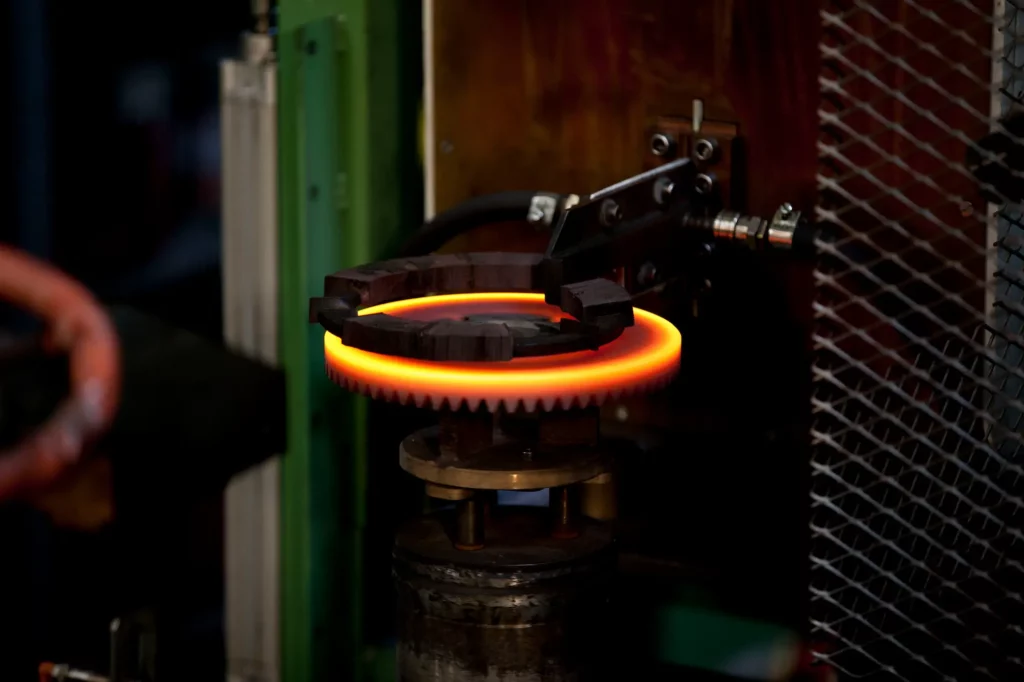
The treatment consists of rapidly heating the surface zone of the part to austenitizing temperature, then subjecting it to vigorous cooling to achieve martensitic transformation of the austenitized part.

Heating is achieved by placing the workpiece in the field of an inductor through which a high-frequency alternating current (50 to 400 kHz) flows. Heat is generated by magnetic hysteresis losses and the Joule effect of induced currents.

Quenching is generally performed "on the fly", with a "follower shower" distributing the quenching liquid. It can also be carried out "statically" with immersion cooling of the part.

The depth affected depends on numerous parameters (material, frequency, power, heating time, quenching performance, part geometry, etc.).

The treatment is fine-tuned by successive trials, and therefore requires a great deal of experience. The settings are then automatically checked in industrial production.

Depending on parameters and part geometry, it is possible to produce :

- Partial, localized treatments by limiting heating to the area to be treated.

- Annealing treatments, income.

- Core treatments (special applications).

Our high-frequency induction hardening treatments are available on the Trempelec site for small parts and large production runs.
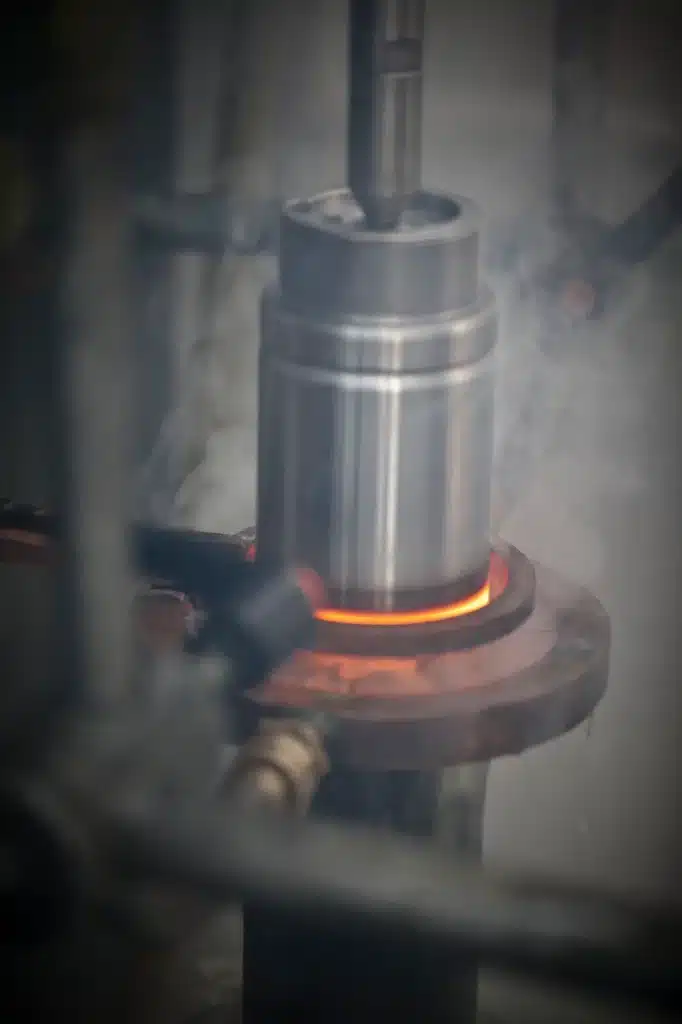
part undergoing induction treatment

Our process

Machine selection

To obtain the best productivity, different machine and generator configurations are used depending on the material, part geometry and number of parts per series:

- Horizontal (e.g. centerless) or vertical feeders.

- Carousel-type multi-station machines

- Dedicated machines with automated loading

Inductor

The design and manufacture of the inductor are crucial to the quality and productivity of the process. For complex parts, they require highly specific know-how.

Control

It particularly concerns the area to be treated, the surface hardness, the depth treated (by cutting and spinning) and, if necessary, the absence of cracks by magnetic particle inspection.

When depth is an imperative, it is necessary to cut a few parts for adjustment and control during production.

Income

After hardening, tempering is recommended to relieve stresses and adjust surface hardness (strongly recommended for subsequent grinding).

    Features and benefits

    performance

    Good wear and fatigue performance from low-cost steels and certain cast irons. This technology is particularly well suited to large production runs, requiring automated part loading.

    precise treatment

    Possibility of local treatment (useful area)

    limited deformations

    Since high-frequency induction hardening is a surface treatment, part deformation is limited.

    For study and order

    Information to be communicated :

    - Material (standardized name)
    - Drawing of the part specifying the areas to be treated
    - Treatment specifications (surface hardness, depth, connection profile if applicable) and particular inspection specifications. It should be noted that a certain number of parts (to be defined) must be cut for fine-tuning and depth control.
    - Number of parts per series, and monthly or annual total.

    Ask for a quote

    business sectors concerned

    Our various documentations
    Heat treatment white paper

    Group brochure

    See all our documentation

    Our FAQs

    What is vacuum deposition?

    Vacuum deposition is a surface treatment used to deposit a material or alloy on a mechanical part.

    The use of vacuum technology ensures a perfectly clean, non-polluting process.

    It is not subject to REACH legislation.

    What are the advantages of PVD technology?

    This process greatly increases resistance to wear, abrasion, friction and corrosion. As a result, component life is greatly extended.

    Standard thicknesses are of the order of 3µm and deposition is carried out on finished parts.

    What's the difference between PVD and PACVD?

    PVD is physical vapor deposition. The element to be deposited is obtained by evaporation or sputtering via a physical process. PACVD is plasma-assisted chemical vapor deposition. The element to be deposited is obtained from chemical reactions. Plasma enables this chemical reaction to take place at lower temperatures.

    What are the industrial applications of vacuum deposition?

    Vacuum deposits are classified into several categories: anti-wear, friction, decorative and biocompatibility. The applications are therefore very varied: automotive components, aerospace, tooling, cutting tools, medical devices, decorative parts...

    How do I choose the right deposit method?

    The deposition method depends above all on the nature of the coating to be deposited and the substrate.

    If the substrate cannot be heated to high temperature, the deposition must be carried out using low-temperature technology.

    If the coating to be deposited consists of a solid element (metal or graphite target), a physical process such as PVD is used. If the coating consists of a gas or liquid, a chemical process such as CVD or PACVD is used.

    What is the purpose of case-hardening? 

    Incorporate carbon below the surface of the steel part to improve fatigue and wear resistance on the surface, while maintaining good core mechanical properties.

    See all FAQs

    Do you have a question or a need?

    Our dedicated team will get back to you.

    Contact us

    Our latest news

    The latest news on heat treatment and vacuum deposition.
    close-up of an aircraft engine illustrating the importance of hardness in safety-critical components
    How can we optimize the hardness of critical and safety components?
    In many industrial sectors, the reliability of critical components is non-negotiable. Whether it's parts used in the automotive, aeronautics, medical or industrial tooling industries, each component must withstand intense mechanical stress while maintaining its performance over the long term. The hardness of a component has a direct influence on its resistance to [...]
    October 29, 2025
    How can we optimize the hardness of critical and safety components?
    heat treatment of massive automotive parts such as crankshafts
    Heat treatments for massive parts in the automotive industry
    The automotive industry relies on components whose performance and reliability must remain constant under demanding operating conditions. Among these, massive parts occupy a strategic position. They transmit power, support loads and ensure the safety of drivers and passengers alike. To ensure that these components can withstand the stresses [...]
    October 22, 2025
    Heat treatments for massive parts in the automotive industry
    PVD and DLC coatings: what are the differences and what uses?
    In demanding sectors such as aerospace, medical, automotive and tooling, surface coatings play a decisive role in the performance and durability of parts. They improve wear resistance, limit friction and improve the adhesion of products to the surface of treated parts. Among the most [...]
    September 29, 2025
    PVD and DLC coatings: what are the differences and what uses?
    Low-pressure carburizing furnace for various industrial applications
    Focus on low-pressure carburizing and its industrial applications
    Mastery of heat treatments is an essential lever for guaranteeing the performance of mechanical parts used in demanding environments. Among the most advanced processes, low-pressure carburizing stands out for its precision and remarkable results. This thermochemical treatment, implemented by specialists such as the Thermilyon Group, meets the most stringent [...]
    September 25, 2025
    Focus on low-pressure carburizing and its industrial applications
    illustration of a person carrying out quality control after heat treatment or vacuum coating
    What quality controls are carried out after heat treatment or vacuum coating?
    In industry, heat treatment and vacuum deposition play a decisive role in improving the performance and durability of metal or alloy parts. To ensure that each part retains its expected mechanical properties and reliability, post-treatment quality control is an essential step. This article describes the main tests performed [...].
    September 3, 2025
    What quality controls are carried out after heat treatment or vacuum coating?
    caregiver sterilizing pvd-coated medical devices
    What are the advantages of vacuum coatings for medical devices?
    In the medical field, every detail counts to guarantee the performance, safety and reliability of instruments used in operating theatres and hospitals. Vacuum coatings have become the benchmark solution for meeting the stringent requirements of the medical sector. These cutting-edge technologies improve the surface characteristics of [...]
    September 24, 2025
    What are the advantages of vacuum coatings for medical devices?