

The aerospace industry operates in an environment where material performance is a prerequisite for safety. Parts used in engines, turbines or fastening systems have to withstand extreme temperatures, repeated friction and thermal variations, often sudden and cyclical. In this quest for reliability, vacuum coatings, and more specifically PVD (Physical Vapor Deposition) treatments, have emerged as solutions to reinforce the resistance of components subjected to high thermal and mechanical stress.
The thermal and mechanical challenges of aeronautics
At over 1000°C, the slightest weakness in a material can compromise the safety of a device. The alloys used in aeronauticstitanium, Inconel, special steels, are already high-performance, but require additional protection against wear, oxidation and deformation.
The most exposed parts, such as turbine blades, engine components or fastening systems, must maintain their structural integrity despite extreme thermal cycles. Surface treatments thus become a major lever for extending the life of materials while maintaining their lightness and efficiency.
The principle of PVD vacuum deposition
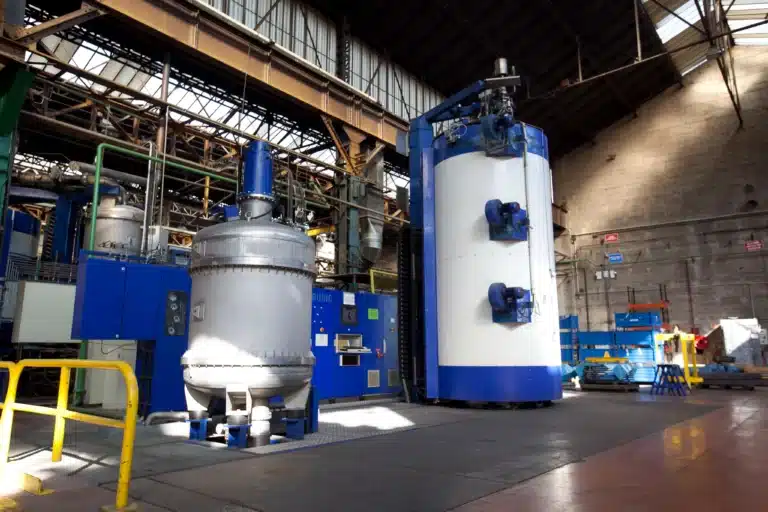
PVD (Physical Vapor Deposition) is a vacuum deposition process that involves evaporating a solid material (such as titanium, chromium or aluminum) to deposit a thin, dense layer on the surface of a part. This operation is carried out in a vacuum chamber, guaranteeing maximum purity and optimum adhesion.
The result is a hard, homogeneous and perfectly controlled coating, capable of withstanding the highest temperatures and friction.
In aeronautics, PVD is particularly appreciated for :
- Its low thickness (just a few microns), which does not affect dimensions or tolerances
- Exceptional heat resistance
- Compatible with a wide range of alloys
High-temperature resistance: performance at the heart of PVD
One of the major advantages of PVD is its stability at high temperatures. Coatings such as TiN (titanium nitride), CrN (chromium nitride) or AlTiN (titanium aluminum nitride) offerexcellent oxidation resistance up to 900-1000°C, or even higher, depending on the formulation.
These coatings create a protective barrier between the material and the environment:
- They limit hydrogen diffusion
- Reduce wear and hot corrosion phenomena
- Improves mechanical resistance in prolonged service
As a result, treated components retain their structural properties even under severe thermal stress, extending their service life and reducing maintenance operations.
Concrete applications in aeronautics
Today, PVD is used on a wide variety of aeronautical parts:
- Turbine blades and disks, exposed to high rotational speeds and gas heat
- Motor components (shafts, segments, fasteners) subject to continuous friction
- Manufacturing tooling used in aerospace production environments, to improve mold and die life.
PVD treatments deliver a unique combination of hardness, resistance to oxidation and wear, and a low coefficient of friction, all of which are essential for the overall performance of the device.
The benefits of PVD vacuum deposition for industry players
In addition to its remarkable resistance to high temperatures, vacuum deposition offers many strategic benefits for the aerospace industry.
Its lightness and precision enable extremely fine coatings to be applied without altering the geometric characteristics of the parts - an essential asset in a sector where every micron counts.
Carried out in a perfectly controlled environment, the process guarantees impeccable cleanliness, protected from any external contamination.
The reproducibility of treatments ensures consistent performance from one part to the next, which is essential to the reliability requirements of the aerospace industry.
Finally, the increased durability of coatings means significantly less wear and tear, fewer replacements and therefore lower operating costs. All advantages that directly address the sector's imperatives of performance, safety and competitiveness.
Vacuum PVD coatings today provide an essential technological response to the thermal challenges facing the aerospace industry. Capable of withstanding extreme temperatures while improving component life and performance, these coatings are becoming a cornerstone of tomorrow's surface solutions. In addition, they can be applied using non-polluting, low-energy processes.
With its know-how and innovative capabilities, the Thermi Lyon group has established itself as a trusted partner for aerospace manufacturers seeking reliability, technical expertise and sustainable performance.