



In industry, heat treatment and vacuum deposition play a decisive role in improving the performance and durability of metal or alloy parts. To ensure that each part retains its expected mechanical properties and reliability, post-treatment quality control is an essential step. This article details the main tests carried out to ensure the quality of heat treatment and vacuum coating, essential elements in meeting the stringent requirements of sectors such as medical, automotive and aerospace.

Why check quality after heat treatment or vacuum deposition?
A heat-treated or vacuum-coated part must meet precise criteria to withstand sometimes extreme mechanical, thermal or chemical stress.
Checking the quality of heat treatment helps prevent failures and extend component life . Quality control acts as an insurance policy for the end customer and the client, while ensuring impeccable traceability at every stage of production.
Dimensional and visual checks
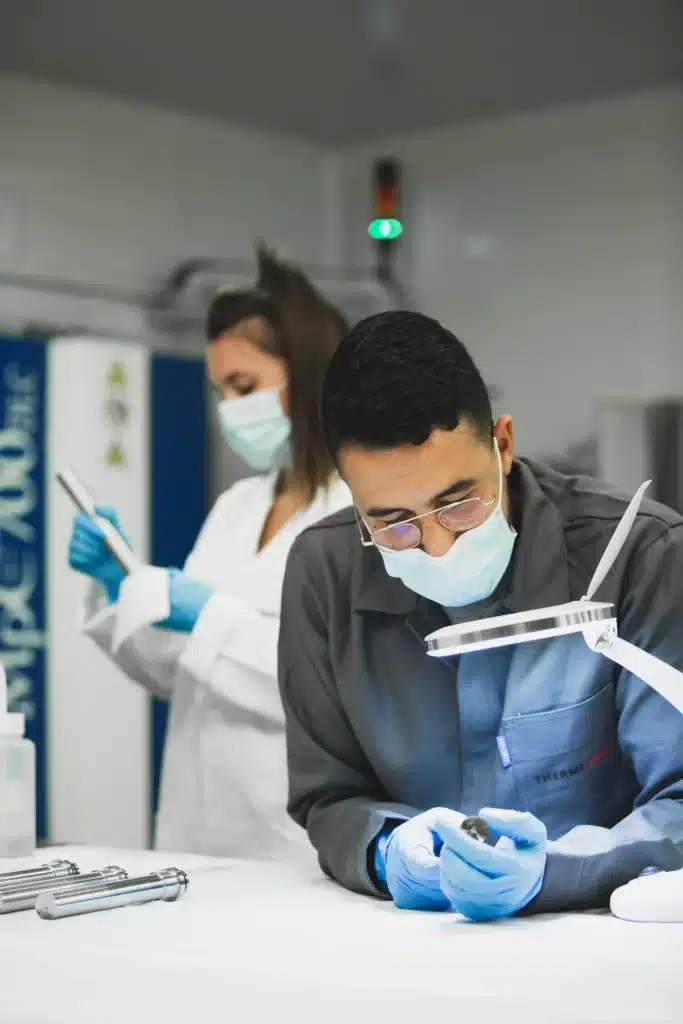
Once processing has been completed, the first checks often concern the appearance and morphology of the parts. Indeed, certain processes can generate slight deformations that need to be corrected or accepted within defined tolerances. Visual inspection completes these checks to detect any cracks, inclusions or signs of oxidation. For vacuum deposition, checking the thickness, adhesion and homogeneity of the deposited layer also helps to validate the quality of the coating, possibly combined with heat treatment.
Hardness testing
Hardness testing remains one of the most telling indicators of heat treatment efficiency. Using various methods, such as Rockwell, Vickers or Brinell hardness measurements, technicians ensure that surface and depth hardness comply with specifications. Controlled hardness is directly linked to greater resistance to wear, corrosion and deformation. Regular monitoring of this parameter therefore plays an active part in the quality of the heat treatment and the trust placed in the service provider.
Microstructure testing
In addition to hardness, microstructure analysis provides a more detailed view of the treatment results. After meticulous sample preparation, microscopic observation confirms the correct distribution of metallurgical phases, grain size and theabsence of internal defects likely to weaken the part. This examination is particularly useful for validating successful nitriding or carburizing , key steps in ensuring optimum heat treatment quality over the long term.
Mechanical strength and fatigue tests
Mechanical testing is essential for parts subjected to high loads. Tensile, bending and impact tests verify the material's ability to withstand high loads without breaking or cracking.
Fatigue testsFatigue tests reproduce repeated stress cycles to anticipate the actual behavior of the part in service. These tests confirm the customer's choice of supplier in terms of heat treatment quality, and demonstrate compliance with the standards of the target sector.
Controls specific to vacuum coatings
When heat treatment is supplemented by vacuum coating, other specific checks come into play. The coating's adhesion must be checked to ensure that it does not flake off during use. Thickness uniformity and any porosity are also analyzed to ensure that the coating plays its full protective or functional role. For certain applications, the coating's color and gloss can also be checked. These parameters contribute directly to the quality of the heat treatment associated with vacuum deposition, particularly in medical or aeronautical applications, where reliability cannot tolerate any defects.
Quality control is essential to validate the effectiveness of a heat treatment or vacuum coating. By combining dimensional inspection, mechanical testing, microstructural analysis and specific checks, Thermi Lyon guarantees its customers consistent quality in line with the most demanding standards. In addition to checks carried out on parts or test coupons, process parameters are recorded, enabling us to verify that treatment cycles have been carried out in accordance with specifications. These quality approaches help to extend the life of parts, reduce the risk of non-conformity and enhance the overall performance of industrial applications.