


Home Annealing

The different types of annealing

There are different types of annealing for different purposes, depending on the requirements:

- Dimensional stability through relaxation of machining, forming and welding stresses : This process is often referred to as stabilization or stress relief. Stress-relieving annealing releases internal stresses accumulated during part manufacture.

- Improved machinability or form ability: Annealing operations adjust the hardness and ductility of the material, enabling improved machinability or formability for steels and specific alloys such as copper or aluminum.

- Structure improvement : Techniques such as normalization, globulation, refining (structure regeneration) and homogenization are employed to obtain a more uniform metal matrix. Each method aims to modify the size and shape of grains and components within the alloy, contributing to better overall material performance.

- Hardness softening to de-fragilize parts after quenching: This type of annealing is crucial for reducing post-quench brittleness and improving the metal's fatigue strength. By precisely controlling temperature and cooling rate, the process achieves the desired hardness while maintaining good ductility. This treatment is also known as " tempering".

- Magnetic annealing : Magnetic annealing is specially designed to restore the magnetic properties of metals affected by previous machining or shaping stresses, such as cold working or cold rolling.

Overall, annealing aims to achieve a stable state of the material, close to equilibrium, through a cycle of heating followed by controlled cooling. These procedures are essential to ensure the functionality and longevity of components in various industrial applications.
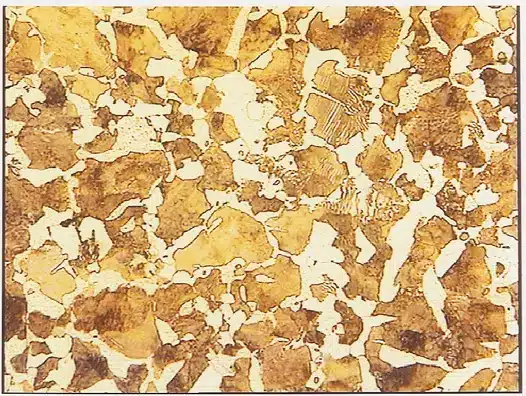
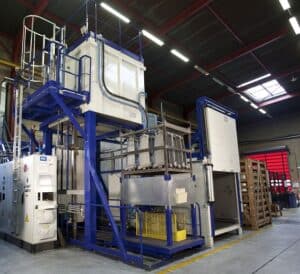
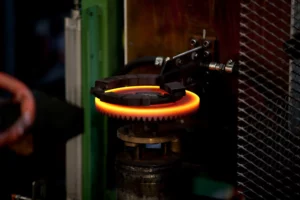
annealing photo

Our annealing process

Annealing can be carried out in air, in a neutral atmosphere (nitrogen, argon) or in a vacuum, suitable for a variety of materials, including alloyed and stainless steels and other metal alloys. This technique ensures modification of the metal structure to obtain optimized mechanical properties, increased ductility and reduced internal stresses.

Heating

Depending on the type of annealing, heating takes place either below the transformation points (AC1 for steel), around 750°C maximum, or above the transformation points (AC3 for steel), around 850/900°C minimum. For some anneals, the heating process enables critical temperatures to be reached for the transformation of the austenite phase into ferrite and carbide, thus promoting recrystallization and the formation of a fine globular structure.

Temperature maintenance

The high-temperature bearing is often held for several hours to ensure complete homogenization of the carbon and other alloying elements within the material. By controlling holding time and temperature, grain size can be controlled to improve the metal's mechanical properties.

Cooling

In general, cooling takes place slowly and regularly in the furnace, to maintain a controlled atmosphere and ensure uniform cooling. For so-called isothermal annealing, cooling can be interrupted at a precise temperature, depending on the steel grade, enabling the desired metallurgical transformations of the steel to take place. This crucial step results in the desired final structure with improved ductility and reduced hardness, facilitating subsequent processes such as stamping or machining.

    Features and benefits

    Softened state

    Low hardness.

    LITTLE FRAGILE

    Improved machinability and shaping

    Restored magnetic properties

    Optimized metallurgical structure

    business sectors concerned

    Our various documentations
    Heat treatment white paper

    Group brochure

    See all our documentation

    Our FAQs

    Why heat treatment?

    Either to improve mechanical performance such as tensile strength, impact strength, wear, seizure or to soften the metal to make it more malleable (machinability, shaping).

    When should a heat treatment be carried out?

    Heat treatment is required when the mechanical performance of the alloys in their natural state needs to be increased. Depending on the type of treatment, heat treatment can be carried out on raw, rough or finished machined parts.

    What do I need to know when requesting or placing an order for heat treatment?

    Type of steel, desired steel characteristics (hardness), quantity of parts per shipment and per year, part drawings and specifications. If possible, the operating mode of the part and its final use.

    What machining allowances need to be taken into account for heat treatment operations?

    Heat treatment reveals different levels of stress from previous stages (manufacturing). These stress relaxations can lead to deformations that must be anticipated at the time of machining. In the case of heat treatment in the mass (quenching, tempering), these extra thicknesses depend on the dimensions of the part, but are of the order of a few tenths to 1 mm.

    To limit the level of deformation, it is advisable to carry out a stabilization treatment on the blank.

    See all FAQs

    Do you have a question or a need?

    Our dedicated team will get back to you.

    Contact us

    Our latest news

    All you need to know about heat treatment.
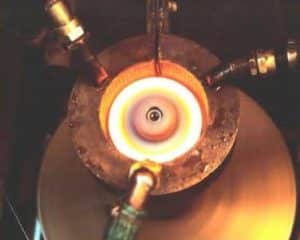
    induction-annealed parts
    What is induction annealing?
    Annealing is one of the best-known heat treatments for metals. Induction, on the other hand, is a heating method based on the diffusion of an electromagnetic current transmitted by an inductor to the surface of parts. The combination of these two technologies is ideal for applying a localized annealing treatment to metal parts.
    June 4, 2024
    What is induction annealing?
    Portrait of Claude Madelmont, Borgwarner collaborator
    Claude Madelmont (Borg Warner): "Groupe ThermiLyon offers cutting-edge treatment".
    "We manufacture components for electric, hybrid or internal combustion cars" The company specializes in the manufacture of automotive components. "We manufacture components for electric, hybrid or internal combustion vehicles: turbos, gearboxes, clutches, motors... We specialize in what's called the powertrain; it's everything [...]
    September 13, 2024
    Claude Madelmont (Borg Warner): "Groupe ThermiLyon offers cutting-edge treatment".
    steel hardening
    Steel hardening: what innovations for industry?
    Hardening steel is one of the most widely used heat treatments for metals. Employed since antiquity, this technique has undergone many evolutions, and no longer simply involves immersing a hot part in cold water or oil. Today, there are several methods of quenching steel, the most recent of which is based on vacuum technology and the use of [...].
    September 16, 2024
    Steel hardening: what innovations for industry?
    What is heat treatment of metals? Why is it useful?
    Nowadays, there are several ways of working industrial metal. Among the most widely used is heat treatment of metals, to modify the appearance, strength and resistance of metal parts. Definition of metal heat treatment Standard NF EN ISO 4885, which replaces standard NF EN 10052, defines [...].
    October 3, 2024
    What is heat treatment of metals? Why is it useful?
    Which heat treatment processes for which applications?
    Heat treatment of metals involves modifying the crystallographic structure of a metal part for a specific purpose. Certain techniques can be used to improve the hardness of parts and increase their resistance to stress. There are many different heat treatment processes for metals, each of which affects different properties. How does the heat treatment of metals work, and how do we choose the best [...]
    September 16, 2024
    Which heat treatment processes for which applications?
    press-hardened part
    Tempering in the press
    What is press quenching? Advantages of the method This technology, which is not yet widespread among contract caterers, is particularly advantageous for the heat treatment of finished parts. It allows quenching without significant deformation, or rather with a level of deformation within the dimensional tolerance of the parts. [...]
    September 13, 2024
    Tempering in the press